 중국의 전기 공기 살포기 제조업체 – 킨지르
세차 후 차량을 건조시키는 것은 디테일링 과정에서 중요한 부분입니다.. 극세사 타월을 많이 사용하지만, 그릴 주변에서는 사용하기 어려울 수 있습니다., 거울, 엠블럼, 바퀴, trim, and other areas where water tends to collect.
ㅏ car blower provides a convenient touch-free way to remove water from these hard-to-reach areas.
A high-power cordless blower can push water out of gaps and seams while reducing the amount of direct contact with the vehicle’s surface. 전문 디테일러를 위한, mobile car-care businesses, and car enthusiasts, it can be a useful addition to a modern vehicle drying routine.
In this guide, we explain how to use a car blower to dry a car safely and efficiently.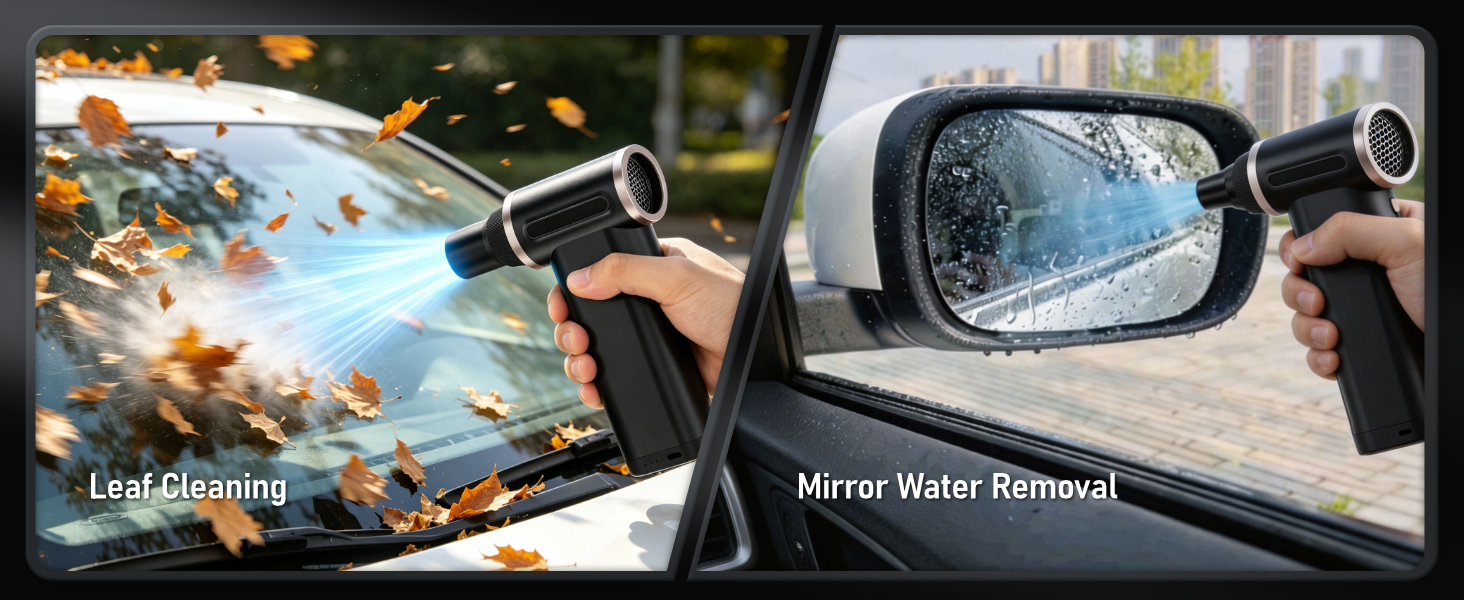
Why Use a Blower to Dry a Car?
After washing, water can remain trapped in many areas of a vehicle.
Common problem areas include:
- 사이드미러
- 도어 핸들
- 그릴
- Car emblems
- 바퀴
- 윈도우 씰
- 차체 패널 간격
- Exterior trim
- Door jambs
- Around lights
A microfiber towel may not easily reach these areas.
A blower uses concentrated airflow to move water away from the vehicle without requiring direct contact.
이는 특히 유용합니다. touch-free car drying and for removing water before the final towel-drying stage.
What Type of Blower Should You Use?
Not every blower is designed for automotive detailing.
For car drying, look for a compact blower with:
Strong Airflow
Sufficient airflow helps move water efficiently across vehicle surfaces and out of narrow gaps.
High Air Speed
High-velocity airflow is useful for pushing water from mirrors, 그릴, 엠블럼, 바퀴, 그리고 다른 어려운 부분.
무선 작동
A battery-powered blower eliminates the need for an extension cable and makes it easier to move around the vehicle.
조정 가능한 속도
Multiple speed settings provide better control for different surfaces and drying situations.
Precision Nozzle
A narrow nozzle can concentrate airflow and help remove water from tight spaces.
Comfortable Weight
A lightweight design is especially important when drying a complete vehicle.
Step-by-Step: How to Dry a Car With a Blower
단계 1: Wash the Car Thoroughly
Before using a blower, make sure the vehicle has been properly washed and rinsed.
Do not use a blower to move large amounts of dirt or grit across an unwashed painted surface.
A typical process is:
Wash → Rinse → Blow Dry → Towel Dry
The blower works best after loose dirt and cleaning products have been removed.
단계 2: Choose the Appropriate Nozzle
Select a nozzle according to the area you are cleaning.
A narrow nozzle is useful for concentrated airflow, while a wider nozzle can cover larger areas.
For detailing work, precision airflow is especially useful around:
- 그릴
- Mirrors
- 엠블럼
- 도어 핸들
- 바퀴
- Trim
- Panel gaps
Make sure the nozzle is securely attached before operating the blower.
단계 3: Start With a Lower Airflow Setting
If your blower has multiple speed settings, start at a lower or medium setting.
This allows you to control the airflow and observe how water moves across the surface.
Once you are comfortable with the airflow, increase the power when necessary.
High power is particularly useful for removing water from larger surfaces or pushing water out of narrow gaps.
단계 4: Start From the Top of the Vehicle
Begin with the roof and upper surfaces.
Work systematically from:
Roof → Windows → Hood → Trunk → Upper Body → Lower Body → Wheels
Starting from the top allows water to move downward rather than repeatedly wetting areas that have already been dried.
Use smooth, controlled movements rather than keeping the airflow concentrated on one spot for an extended period.
단계 5: Dry the Roof and Glass
Start by directing airflow across the roof.
Keep the nozzle at a reasonable distance from the surface and use a controlled sweeping motion.
Then move to the windows and glass.
The goal is not necessarily to remove every drop of water immediately. 대신에, use the airflow to move the majority of the water toward the edges of the vehicle.
단계 6: Blow Water From Mirrors
Side mirrors are one of the most useful applications for a car blower.
Water can remain inside mirror housings and around the edges of the mirror.
Direct airflow around the mirror housing and seams.
A precision nozzle can help push water out of these narrow spaces.
This is particularly useful because water trapped inside the mirror assembly may drip onto the vehicle later.
단계 7: Clean Around Grilles and Emblems
Grilles and badges contain many small openings where water can remain after washing.
Use concentrated airflow to remove water from:
- Front grille
- Rear grille areas
- Manufacturer badges
- Model emblems
- Decorative trim
Move the nozzle around the area instead of concentrating airflow on a single point.
This allows water to escape from multiple directions.
단계 8: Dry Door Handles and Panel Gaps
도어 핸들, seams, and trim pieces can hold surprising amounts of water.
Use a precision nozzle to blow around:
- 도어 핸들
- Window trim
- Door seams
- Panel gaps
- Exterior molding
- 윈도우 씰
This helps reduce water dripping onto already-dried surfaces.
단계 9: Dry the Wheels
Wheels are another excellent application for a high-power car blower.
Water can remain around:
- Spokes
- Lug nuts
- Wheel rims
- Brake components
- Wheel arches
Use controlled airflow to remove water from these areas.
For wheels with intricate designs, a blower can reach areas where a towel is difficult to position.
단계 10: Blow Out the Door Jambs
After the main exterior surfaces are dry, open the doors and inspect the door jambs.
Water commonly remains around:
- Door seals
- Hinges
- Door edges
- Latches
- Drain areas
A blower can quickly remove remaining water from these areas.
This is particularly useful during professional detailing because door jambs are often overlooked during quick exterior drying.
단계 11: Use a Microfiber Towel for the Final Finish
A car blower does not necessarily need to replace your microfiber towels.
In many detailing workflows, the best approach is to use both.
The blower removes water from gaps and difficult areas, while the microfiber towel can remove remaining moisture from accessible painted surfaces.
A practical process is:
1. Blow away the majority of the water.
2. Use the blower around seams, trim, 거울, and emblems.
3. Finish accessible surfaces with a clean microfiber towel.
This combination can reduce unnecessary towel contact while providing a clean final finish.
How to Dry a Car Without Touching It
One of the main benefits of a car blower is the possibility of touch-free drying.
Instead of dragging a towel across the entire vehicle, airflow can be used to remove a significant amount of surface water.
A typical touch-free drying sequence is:
1. Rinse the vehicle thoroughly
Remove as much loose dirt as possible.
2. Allow excess water to drain
Give the vehicle a moment to shed standing water.
3. Use a blower from the top down
Move water toward the lower sections of the vehicle.
4. Focus on water-trapping areas
Pay particular attention to mirrors, trim, 배지, 그릴, handles, and wheels.
5. Use a towel only where necessary
Finish remaining water spots with a suitable microfiber towel.
This approach can help minimize physical contact with the vehicle’s exterior during the drying process.
How Close Should You Hold a Car Blower?
There is no single distance that is appropriate for every blower, nozzle, vehicle surface, or airflow setting.
As a general practice, start farther away and gradually move closer if more concentrated airflow is required.
Avoid pressing the nozzle against the vehicle.
섬세한 표면용, painted finishes, loose trim, or sensitive components, use lower airflow and greater distance.
Always follow the blower manufacturer’s operating instructions.
Should You Use a Blower on a Ceramic-Coated Car?
A blower can be particularly convenient for drying vehicles with ceramic coatings or other paint-protection treatments because coated surfaces can allow water to sheet or bead more readily.
하지만, the blower itself does not replace proper washing and maintenance.
The vehicle should still be washed using an appropriate method before drying.
A blower can then be used to move water from the coated surface and remove water trapped around trim, 배지, 거울, and other areas.
Common Mistakes When Using a Car Blower
Mistake 1: Blowing a Dirty Car
Avoid using strong airflow to move loose dirt across a dry or heavily contaminated painted surface.
Always wash and rinse the vehicle first.
Mistake 2: Using Maximum Power Everywhere
Maximum airflow is not always necessary.
Use an appropriate speed for the specific application.
Mistake 3: Holding the Nozzle Too Close
Very concentrated airflow can be unnecessary on delicate areas.
Start at a reasonable distance and adjust according to the situation.
Mistake 4: Ignoring the Wheels and Gaps
Water often remains in wheels, 거울, 그릴, 배지, and trim even when the main body panels appear dry.
These areas should be included in the drying process.
Mistake 5: Using a Dirty Nozzle
The blower nozzle should be kept clean.
Dirt or debris on the nozzle can potentially come into contact with the vehicle during use.
무선 송풍기 대. Compressed Air for Car Drying
Both cordless blowers and compressed-air systems can be useful in automotive applications, but they serve different needs.
| 특징 | Cordless Car Blower | Compressed Air System |
|---|---|---|
| 이식성 | 훌륭한 | 제한된 |
| 전원 | 충전식 배터리 | 압축기 |
| Setup time | Very low | Higher |
| Extension hose | Not required | 일반적으로 필수 |
| 모바일 디테일링 | 훌륭한 | 덜 편리함 |
| Precision drying | Excellent with suitable nozzle | 훌륭한 |
| Workshop applications | 훌륭한 | 훌륭한 |
| 저장 | 콤팩트 | Requires more space |
For a fixed workshop, compressed air remains a practical option.
을 위한 mobile detailing, DIY car care, 대리점, and quick vehicle drying, a cordless blower provides greater freedom of movement.
Benefits of Using a Cordless Blower for Car Detailing
A well-designed cordless blower can provide several advantages:
Touch-Free Cleaning
Reduce the amount of direct contact needed during drying.
Easy Access
Reach narrow gaps and difficult areas.
Portable Operation
Move freely around the vehicle without managing a power cable.
Faster Drying
Quickly remove water from multiple areas.
다양한 용도
Use the same blower for vehicle interiors, 바퀴, 차고, 워크샵, and other cleaning applications.
소형 저장
Store the tool easily in a detailing van, 차고, 작업장, 또는 차량.
Choosing the Best Car Blower for Your Needs
When selecting a car drying blower, consider more than the maximum air-speed specification.
Look at the complete product design:
- 기류 성능
- Air velocity
- BLDC 모터
- 배터리 용량
- 실행 시간
- 충전 시간
- 무게
- 소음 수준
- 속도 제어
- Nozzle design
- 인간 공학
- Product durability
The best cordless blower is one that provides the right combination of performance, 이식성, control, and convenience for the intended application.
From Car Drying to Complete Automotive Detailing
A cordless blower can do much more than dry a freshly washed car.
With the right design, it can become a versatile automotive detailing tool ~을 위한:
- Car drying
- 먼지 제거
- Wheel cleaning
- Grille cleaning
- Interior detailing
- 환풍구 청소
- Water removal from gaps
- Workshop cleaning
- 모바일 디테일링
When combined with a 무선 휴대용 진공청소기, it can provide a complete blow-and-vacuum solution for automotive cleaning.
The blower loosens and removes water or loose debris, while the vacuum collects dust, 애완동물 털, 부스러기, and other particles.
OEM/ODM Car Blower Manufacturer
We are a professional manufacturer specializing in high-power cordless blowers and handheld vacuum cleaners for automotive, 집, pet-care, 집 밖의, 전문적인 응용 프로그램.
Our cordless blowers can be developed for car drying and automotive detailing applications, with customization options including:
- BLDC motor configuration
- 기류 성능
- Air speed
- Battery configuration
- Charging system
- Speed settings
- Nozzle design
- Product appearance
- 제품 색상
- 로고 및 브랜딩
- 포장
- 부속품
Whether you are an automotive detailing brand, car-care company, 살수 장치, 소매점, dealership, or OEM/ODM buyer, we can support your product development from concept to mass production.
마지막 생각들
Learning how to use a car blower to dry a car is simple, but using the right technique can make the process much more effective.
Wash and rinse the vehicle first, start from the top, use controlled airflow, pay special attention to water-trapping areas, and finish with a microfiber towel when necessary.
For professional detailers and car enthusiasts, a high-power cordless blower can be a valuable addition to the detailing toolbox—providing portable, 정밀한, and convenient airflow wherever it is needed.
Looking for a cordless car blower for your automotive product line? Contact us to discuss OEM/ODM solutions.