 Electric Air Duster Manufacturer in China – Kinzir
 Keeping a vehicle clean requires the right tools for the job. For car owners, professional detailers, dealerships, and automotive workshops, two common options are a cordless car vacuum and a traditional shop vacuum.
Both can remove dirt, dust, crumbs, pet hair, and other debris from a vehicle. However, their designs are very different, and each has advantages depending on the cleaning environment and application.
A traditional shop vacuum is generally designed for high-capacity, heavy-duty cleaning, while a cordless handheld car vacuum focuses on portability, convenience, and quick cleaning.
So which one should you choose?
The answer depends on how, where, and how often you clean your vehicle.
What Is a Cordless Car Vacuum?
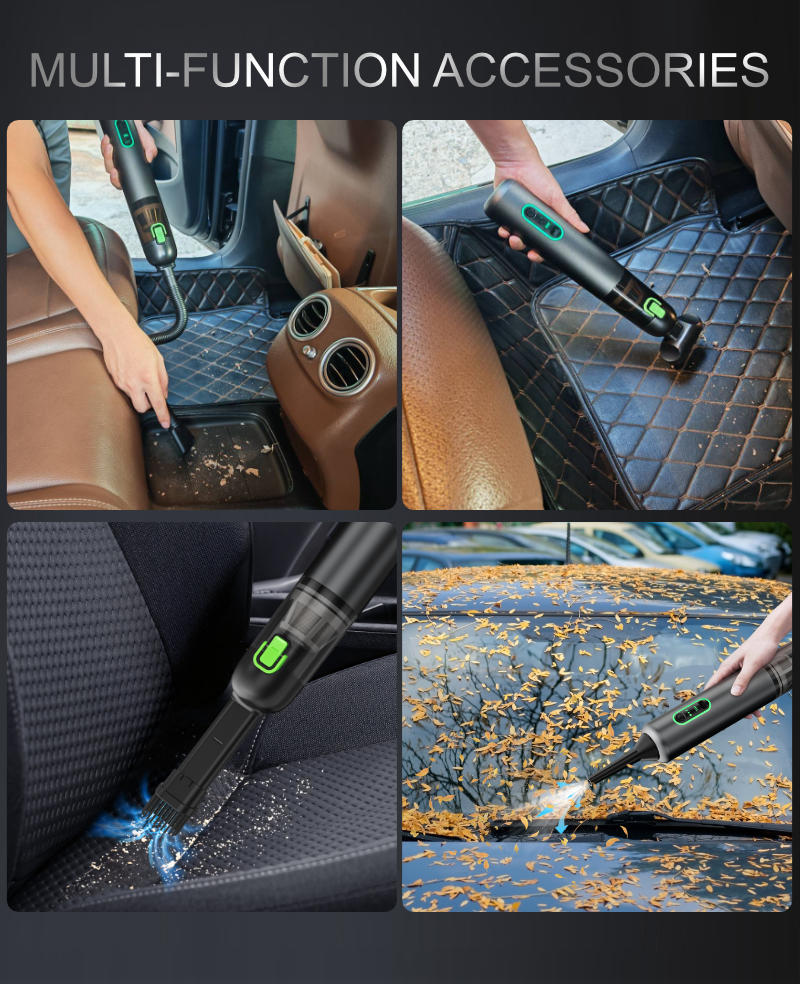
A cordless car vacuum is a compact vacuum cleaner powered by a rechargeable battery.
Unlike traditional corded vacuum cleaners, it does not require a wall outlet during operation. Its compact body and lightweight design make it easy to move around the interior of a vehicle.
A cordless handheld vacuum can be used for:
- Car seats
- Floor mats
- Carpets
- Center consoles
- Cup holders
- Door pockets
- Seat gaps
- Trunk areas
- Dashboards
- Pet hair
Many modern models use BLDC motors to provide strong suction in a compact form factor.
For quick cleaning and everyday vehicle maintenance, a cordless vacuum can be kept in a garage, detailing area, or vehicle and used whenever needed.
What Is a Traditional Shop Vacuum?
A traditional shop vacuum, also known as a wet/dry vacuum in many applications, is generally designed for workshops, garages, construction environments, and heavy-duty cleaning.
These vacuums typically feature:
- Larger dust containers
- Larger motors
- Long hoses
- Higher capacity
- Corded operation
- Multiple accessories
Their larger capacity makes them suitable for collecting significant amounts of dust, dirt, debris, and other materials.
For professional workshops and intensive cleaning tasks, a shop vacuum can be a practical choice.
However, the larger size and corded design can make it less convenient for quick car cleaning.
Cordless Car Vacuum vs. Traditional Shop Vacuum
The two products are designed with different priorities.
| Feature | Cordless Car Vacuum | Traditional Shop Vacuum |
|---|---|---|
| Portability | Excellent | Limited |
| Power source | Rechargeable battery | AC power |
| Cord | No | Usually required |
| Size | Compact | Larger |
| Dust capacity | Smaller | Larger |
| Quick cleaning | Excellent | Good |
| Heavy-duty cleaning | Model dependent | Excellent |
| Vehicle interior | Excellent | Excellent |
| Mobile detailing | Very suitable | Less convenient |
| Storage | Easy | Requires more space |
| Setup time | Minimal | More setup required |
The right choice depends on the user’s priorities.
1. Portability
Portability is one of the biggest differences between a cordless car vacuum and a shop vacuum.
A cordless handheld vacuum can be carried directly to the vehicle and used immediately.
There is no need to:
- Find a power outlet
- Unwind a long cable
- Carry a large vacuum body
- Move a long hose around the vehicle
This makes cordless vacuums particularly convenient for mobile detailing and everyday car maintenance.
A shop vacuum, on the other hand, is usually better suited to a fixed garage or workshop where the vacuum can remain in one location.
2. Ease of Use
For small cleaning tasks, convenience matters.
Imagine finding crumbs on a car seat or pet hair on the floor mat. With a cordless vacuum, the cleaning process can be as simple as picking up the vacuum and turning it on.
There is minimal preparation.
A traditional shop vacuum may require moving the vacuum, connecting the hose, plugging it in, and selecting the appropriate attachment.
For large cleaning jobs, this extra setup may not be a major issue.
For quick daily cleaning, however, a cordless vacuum can save time.
3. Cleaning a Car Interior
Both types of vacuum can clean vehicle interiors, but their usability can be different.
A cordless handheld vacuum is designed around mobility.
Its compact size makes it easier to reach:
- Under seats
- Between seats
- Around the center console
- Inside door pockets
- Around cup holders
- Inside storage compartments
- Around dashboard controls
A shop vacuum can also reach these areas using a hose and suitable attachments, but the larger main unit generally needs to remain nearby.
For detailed interior cleaning, the flexibility of a handheld vacuum can be particularly useful.
4. Suction Performance
Suction power is one of the most important considerations when choosing a vacuum.
Traditional shop vacuums often use larger motors and are designed for demanding cleaning environments.
However, modern cordless car vacuums can also provide strong suction through high-speed BLDC motor technology.
When comparing vacuum performance, users should look beyond a single advertised number.
Important factors include:
- Motor speed
- Suction pressure
- Airflow
- Nozzle design
- Filter design
- Battery output
- Dust container design
For example, a compact vacuum with an optimized airflow system and nozzle can provide effective cleaning performance despite its smaller physical size.
5. Battery vs. Corded Power
The power source creates another major difference.
Cordless Car Vacuum
A rechargeable battery provides freedom of movement.
Users can clean the vehicle without being connected to an electrical outlet.
This is useful for:
- Outdoor cleaning
- Mobile detailing
- Parking lots
- Road trips
- Car dealerships
- Quick home cleaning
Traditional Shop Vacuum
A corded shop vacuum provides continuous access to electrical power.
This makes it suitable for longer cleaning sessions where battery runtime is not a concern.
For a professional workshop with convenient electrical outlets, corded operation can be an advantage.
For mobile use, cordless operation is generally more convenient.
6. Battery Runtime
Battery runtime is an important consideration when choosing a cordless car vacuum.
The required runtime depends on the application.
For quick maintenance cleaning, users may only need several minutes of operation.
For professional detailing, longer runtime may be preferred.
When evaluating a cordless vacuum, consider:
- Battery capacity
- Motor power
- Operating mode
- Charging time
- Runtime at different power levels
- Battery replacement options
Some cordless vacuums provide multiple power settings, allowing users to balance suction performance and battery runtime.
7. Dust Capacity
This is an area where traditional shop vacuums have a clear design advantage.
A shop vacuum generally has a much larger collection container.
This makes it suitable for:
- Large workshops
- Heavy debris
- Long cleaning sessions
- Garage cleaning
- Construction-related cleaning
A cordless car vacuum has a smaller dust cup because portability and compact size are priorities.
For vehicle interiors, however, a smaller dust cup is often sufficient for routine cleaning.
The dust cup can simply be emptied after use.
8. Pet Hair and Fine Debris
Pet owners often face a particular challenge: pet hair can become embedded in car carpets and upholstery.
A cordless handheld vacuum with an appropriate brush or nozzle can be convenient for removing:
- Dog hair
- Cat hair
- Food crumbs
- Sand
- Dust
- Small debris
For heavily contaminated surfaces, a larger shop vacuum may provide greater capacity and continuous operation.
For routine pet-hair cleanup, however, the convenience of a cordless handheld vacuum can make frequent cleaning easier.
9. Filtration
Filtration is another important factor when selecting a car vacuum.
Vehicle interiors can contain dust, fine particles, hair, and other debris.
A multi-stage filtration system can help capture particles during vacuuming.
Depending on the product design, a cordless car vacuum may use combinations such as:
Mesh Filter → Fine Filter → HEPA Filter
A washable filter can also simplify routine maintenance.
When comparing products, users should consider not only the presence of a HEPA filter but also the overall filtration design, sealing, airflow, and ease of maintenance.
10. Noise and Comfort
A vacuum’s size and motor design can affect the user experience.
A large shop vacuum can generate significant operating noise, particularly in enclosed garages or workshops.
A compact cordless vacuum may provide a more convenient solution for quick cleaning, although actual noise levels vary between models.
For professional detailers who use cleaning equipment throughout the day, factors such as:
- Noise
- Weight
- Handle design
- Vibration
- Balance
can become just as important as suction performance.
11. Storage
Storage is often overlooked when choosing a car vacuum.
A traditional shop vacuum can take up considerable space in a garage or workshop.
A compact cordless vacuum can usually be stored in:
- A car trunk
- Garage cabinets
- Toolboxes
- Workshop shelves
- Detailing vans
- Utility rooms
This makes cordless vacuums attractive to users who want a cleaning tool that is always within reach.
12. Which Vacuum Is Better for Professional Car Detailing?
Professional detailers may actually benefit from having both types of vacuum.
A shop vacuum can be used for large or intensive cleaning jobs where capacity and continuous operation are important.
A cordless handheld vacuum can be used for quick cleaning, spot cleaning, and areas where portability is more important.
For example:
Shop Vacuum:
Deep-clean the entire vehicle interior and handle large amounts of debris.
Cordless Vacuum:
Quickly clean cup holders, seats, door pockets, floor mats, and other small areas between jobs.
The two products can therefore complement each other rather than simply compete with each other.
13. Which Vacuum Is Better for Mobile Detailing?
For mobile detailing, portability becomes much more important.
Mobile detailers may work at:
- Customer homes
- Office parking lots
- Apartment complexes
- Dealerships
- Outdoor locations
- Fleet parking areas
In these situations, a large corded shop vacuum can be more difficult to transport and operate.
A cordless car vacuum eliminates the need for a nearby electrical outlet and provides greater freedom of movement.
This makes it particularly suitable for mobile car detailing and on-the-go vehicle maintenance.
14. Which Vacuum Is Better for Everyday Car Owners?
For most everyday car owners, cleaning needs are usually relatively simple.
Typical tasks include:
- Removing crumbs
- Cleaning floor mats
- Removing pet hair
- Cleaning seats
- Cleaning the trunk
- Removing dust
- Cleaning cup holders
For these tasks, a compact cordless vacuum can be convenient because it is easy to store and quick to operate.
Instead of waiting until the vehicle becomes heavily dirty, owners can perform short cleaning sessions regularly.
15. Can a Cordless Car Vacuum Replace a Shop Vacuum?
Not in every situation.
A cordless car vacuum and a shop vacuum are designed around different priorities.
A shop vacuum is generally better suited to high-capacity and heavy-duty cleaning.
A cordless handheld vacuum is designed for portability, convenience, and quick cleaning.
For a professional workshop, a large shop vacuum may remain an important piece of equipment.
For everyday vehicle care and mobile detailing, a cordless vacuum can provide a more convenient solution.
The choice should therefore be based on the intended application rather than simply comparing maximum motor power.
How to Choose the Right Cordless Car Vacuum
If you are considering a cordless vacuum specifically for automotive applications, pay attention to the following features.
Strong Suction
Choose a model with sufficient suction for carpets, upholstery, pet hair, crumbs, and everyday debris.
Compact Design
A smaller body makes it easier to clean narrow areas inside a vehicle.
Lightweight Construction
A balanced and lightweight design improves comfort during extended cleaning.
Multiple Attachments
Crevice tools and brush attachments can improve cleaning performance in different areas.
Efficient Filtration
A good filtration system helps capture fine dust and makes the vacuum more suitable for enclosed vehicle interiors.
Easy Dust-Cup Maintenance
The dust cup should be easy to remove, empty, and clean.
Reliable Battery System
Choose battery capacity and charging performance according to the expected cleaning time.
Why BLDC Technology Matters in Cordless Car Vacuums
Modern cordless handheld vacuums increasingly use brushless DC motors.
BLDC motors can operate at high rotational speeds while maintaining a compact motor size.
This gives manufacturers more flexibility when designing portable vacuum cleaners.
By optimizing the motor, impeller, airflow channel, filter, battery, and nozzle together, manufacturers can develop a compact vacuum that delivers strong cleaning performance.
For automotive applications, this makes BLDC technology particularly useful for creating lightweight and portable car-care tools.
Cordless Car Vacuum and Blower: A Complete Car-Care Solution
A cordless vacuum does not have to work alone.
For automotive detailing, combining a cordless blower and handheld vacuum can create a more complete cleaning workflow.
The blower can be used to:
- Remove water
- Loosen dust
- Clean air vents
- Clear debris from gaps
- Dry mirrors and grilles
The vacuum can then be used to:
- Collect dust
- Remove pet hair
- Pick up crumbs
- Clean carpets
- Clean seats
- Clean floor mats
This blow-and-vacuum approach can be useful for both professional detailers and everyday car owners.
OEM/ODM Cordless Car Vacuum Manufacturer
We are a professional manufacturer specializing in cordless handheld vacuum cleaners and high-power cordless blowers for automotive, home, pet-care, outdoor, and professional applications.
Our automotive vacuum solutions can be customized according to different market requirements, including:
- BLDC motor configuration
- Suction performance
- Battery configuration
- Filtration system
- Dust-cup capacity
- Nozzle and accessory design
- Product appearance
- Product color
- Logo and branding
- Packaging
We support OEM and ODM projects for automotive brands, car-care companies, distributors, retailers, professional detailing businesses, and other customers.
From product development and engineering to mass production and packaging, we can provide integrated manufacturing support for your cordless car-care products.
Final Thoughts
The choice between a cordless car vacuum and a traditional shop vacuum ultimately depends on the cleaning environment and intended use.
A traditional shop vacuum is well suited to large-capacity, heavy-duty, and continuous cleaning.
A cordless car vacuum focuses on portability, quick operation, easy storage, and flexible vehicle cleaning.
For many automotive applications, these two tools are not necessarily alternatives. A shop vacuum can handle deep and heavy cleaning, while a cordless handheld vacuum can make everyday and spot cleaning faster and more convenient.
For professional detailing and modern car care, adding a cordless vacuum to the cleaning toolkit can provide greater flexibility—especially when portability and quick access are important.
Looking for a cordless car vacuum for your automotive product line? Contact us to discuss OEM/ODM development and manufacturing solutions.