 Electric Air Duster Manufacturer in China – Kinzir
Introduction: The Suction Power Myth
When choosing a vacuum cleaner, many consumers immediately look for one specification: suction power.
A common belief is:
“The higher the suction power, the better the vacuum cleaner.”
Manufacturers often highlight impressive numbers such as 15KPa, 20KPa, or even higher suction pressure, while motor speeds can reach tens of thousands of RPM.
But does a higher number always mean better cleaning performance?
The answer is: not necessarily.
A truly effective vacuum cleaner is not only about maximum suction power. It is the result of a combination of factors, including motor performance, airflow design, filtration efficiency, battery technology, and nozzle structure.
Understanding these factors will help consumers choose a vacuum cleaner that delivers better real-world cleaning results.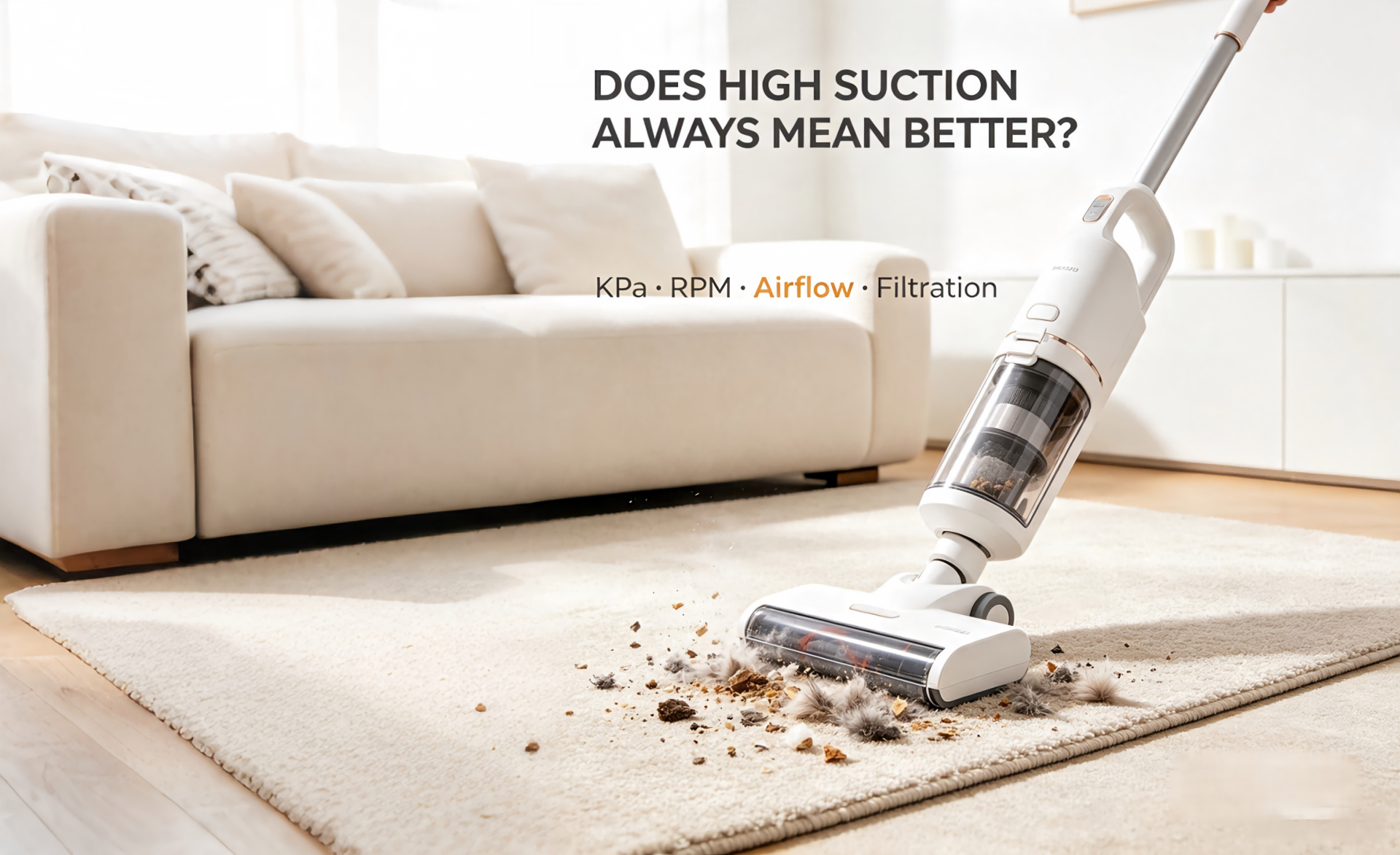
1. What Does KPa Mean in a Vacuum Cleaner?
Understanding Vacuum Suction Pressure
KPa stands for kilopascal, a unit used to measure vacuum pressure.
In simple terms:
KPa indicates how strongly a vacuum cleaner can create negative pressure to pull air and dust into the machine.
A higher KPa value generally means stronger pulling force.
For example:
- 5KPa: Suitable for light dust and small particles
- 10KPa: Good for daily household cleaning
- 15KPa or above: Suitable for deeper cleaning tasks
However, suction pressure is only one part of the cleaning process.
A vacuum cleaner with extremely high KPa but poor airflow design may not perform better than a well-designed model with balanced suction.
2. What Does RPM Mean and Why Is the Motor Important?
The Role of Motor Speed
RPM means revolutions per minute.
It represents how fast the motor rotates.
Modern cordless vacuum cleaners often use BLDC (Brushless DC) motors, which can achieve very high speeds, sometimes exceeding:
- 50,000 RPM
- 70,000 RPM
- 100,000+ RPM
A high-speed motor helps generate stronger airflow and improves overall performance.
However:
Higher RPM does not automatically equal better cleaning.
The motor must work together with:
- Fan blade design
- Air channel structure
- Battery output
- Heat management system
A poorly optimized high-speed motor may create more noise and consume more energy without providing a significant cleaning advantage.
3. Why Suction Power Alone Does Not Determine Cleaning Ability
Many people focus only on suction pressure, but actual cleaning performance depends on several key technologies.
① Airflow Efficiency
A vacuum cleaner does not simply “pull” dust.
It creates a complete airflow system:
Air inlet → Motor → Filter → Air outlet
If the airflow path is restricted, suction performance decreases.
A well-designed airflow system can maintain stable cleaning power even during longer operation.
② Motor Performance
A powerful motor provides:
- Stronger airflow generation
- Stable suction
- Better performance on different surfaces
Modern cordless vacuum cleaners use high-efficiency BLDC motors because they provide:
✔ High speed
✔ Long lifespan
✔ Lower energy consumption
✔ Reduced maintenance requirements
③ Filtration System
Strong suction is meaningless if dust escapes back into the environment.
A good filtration system is essential.
Many advanced vacuum cleaners use:
- HEPA filters
- Stainless steel mesh filters
- Multi-stage filtration systems
These technologies help capture fine dust particles and reduce secondary pollution.
This is especially important for:
- Families with pets
- Allergy-sensitive users
- Indoor environments
④ Nozzle Design
The connection between the vacuum cleaner and the cleaning surface is also critical.
A well-designed nozzle can improve:
- Dust collection efficiency
- Cleaning coverage
- Edge cleaning performance
For example:
A narrow nozzle works well for:
- Car seat gaps
- Keyboard cleaning
- Sofa corners
A wider nozzle is better for:
- Floors
- Large surfaces
4. Why Wireless Vacuum Cleaners Are Becoming More Popular
Traditional vacuum cleaners often provide strong performance but have several limitations:
- Large size
- Difficult storage
- Limited movement due to cables
- Not convenient for quick cleaning
Wireless handheld vacuum cleaners solve these problems.
Modern consumers prefer products that are:
✔ Lightweight
✔ Portable
✔ Easy to store
✔ Ready to use anytime
A compact vacuum cleaner can handle daily cleaning tasks such as:
- Car interiors
- Desk surfaces
- Sofas
- Pet hair
- Small dust particles
5. The Importance of Battery Technology
For cordless vacuum cleaners, battery performance directly affects user experience.
A powerful motor requires a reliable power source.
A good battery system should provide:
- Stable voltage output
- Long working time
- Safe charging performance
- Efficient energy usage
Advanced battery management systems help protect:
- Battery life
- Motor operation
- Product safety
This allows users to enjoy powerful cleaning performance without worrying about frequent charging.
6. The Future Trend: More Than Just Powerful Suction
The future of vacuum cleaners is not simply about achieving higher suction numbers.
Consumers are looking for a better overall experience.
Future vacuum cleaners will focus on:
Lightweight Design
Products will become smaller and easier to handle.
Multi-function Cleaning
Vacuum cleaners will combine multiple functions:
- Vacuuming
- Blowing
- Portable cleaning
Smart Performance Control
Different cleaning modes will automatically adjust power according to usage scenarios.
Quiet Operation
Lower noise levels will become increasingly important, especially for home environments and vehicles.
7. How to Choose the Right Vacuum Cleaner?
Instead of only asking:
“How many KPa does it have?”
Consumers should consider:
1. Suction Performance
Does it provide enough power for your cleaning needs?
2. Motor Technology
Is it equipped with an efficient motor system?
3. Filtration System
Can it effectively capture fine dust?
4. Battery Life
Can it complete cleaning tasks without frequent charging?
5. Product Design
Is it convenient for your daily lifestyle?
Conclusion: Real Cleaning Performance Comes From Balance
A vacuum cleaner with higher suction power is not always the best choice.
The best cleaning performance comes from the balance between:
Motor speed + suction pressure + airflow design + filtration + battery efficiency + user-friendly design
A well-engineered cordless vacuum cleaner does not simply chase higher numbers.
It focuses on delivering:
- Strong cleaning ability
- Comfortable operation
- Reliable performance
- Convenience in everyday life
Because the best vacuum cleaner is not the one with the biggest specifications.
It is the one that makes cleaning easier.